
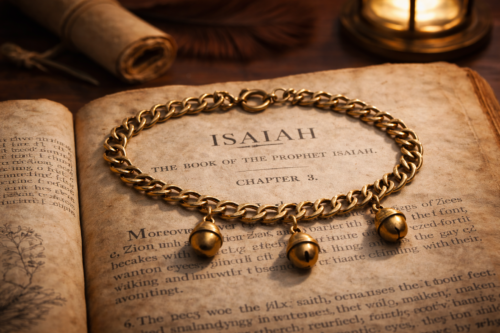
The Bible is full of vivid imagery, and sometimes the smallest details spark the biggest questions. One such detail is the mention of anklet chain from the book of isaiah At first glance, it may seem odd as why would a prophet sent by God speak about jewelry? Yet, as with many prophetic passages, there is a deep spiritual message behind this seemingly simple reference.
In this article, we’ll explore where anklet chains appear in Isaiah, what they meant in biblical times, why God called them out, and what lessons modern readers—especially Christians—can draw from this passage today.
Anklet chain from the book of isaiah (Isaiah 3:16–24)
The mention of anklet chains comes from Isaiah chapter 3, specifically verses 16 through 24. This passage is part of a larger prophecy where God, speaking through Isaiah, pronounces judgment on Judah and Jerusalem because of their pride, injustice, and moral decay.
Isaiah addresses a specific group called the “daughters of Zion.” These were women of wealth and status in Jerusalem—likely members of the upper class—who enjoyed luxury, attention, and social privilege.
In this passage, God describes their appearance in detail: their posture, their clothing, their jewelry, and even the way they walked. Among the long list of ornaments are anklets or anklet chains, which were worn in a way that drew attention as the women walked.
This was not random commentary. In prophetic writing, details matter. Every item mentioned represents something deeper about the spiritual condition of the people.
Who Were the Daughters of Zion?
The “daughters of Zion” were not condemned simply for being women or for enjoying beauty. Rather, they symbolized a culture of pride, self-indulgence, and misplaced identity.
At the same time that these women enjoyed luxury:
-
The poor were oppressed
-
Leaders were corrupt
-
Justice was neglected
-
God was pushed aside
Their outward beauty stood in sharp contrast to the inward decay of the nation.
What Were Anklet Chains in Ancient Israel?
To fully understand the passage, we need to step into the historical and cultural context of the ancient Near East.
Anklets as Status Symbols
Anklet chains were:
-
Made of gold, silver, or bronze
-
Sometimes decorated with charms or bells
-
Designed to jingle or make sound when walking
These were not ordinary accessories. They were luxury items, worn primarily by wealthy women to:
-
Display social status
-
Draw attention
-
Enhance elegance and sensuality
In some cultures, anklet chains were connected between both ankles, forcing the wearer to take short, deliberate steps, further emphasizing posture and movement.
Anklets as a Symbol of Wealth, Pride, and Display
In Isaiah’s time, anklet chains symbolized:
-
Excessive luxury
-
Pride in appearance
-
A desire to be noticed
-
Confidence rooted in wealth rather than God
This is why God included anklets in the list of adornments. They were not neutral fashion items in this context—they were symbols of a heart posture.
The Biblical Meaning of Anklet Chains in Isaiah
So what do anklet chains represent spiritually in the Book of Isaiah?
A Symbol, Not a Sin
Importantly, the Bible does not teach that anklets themselves are sinful. Jewelry is mentioned positively in other parts of Scripture. The issue in Isaiah 3 is not adornment, but attitude.
In this passage, anklet chains symbolize:
-
Pride and arrogance
-
Dependence on outward beauty
-
Self-glorification
-
Ignoring God while enjoying His blessings
God was addressing a people who had become more concerned with appearance than obedience, more invested in luxury than righteousness.
In Isaiah, anklet chains represent the danger of allowing outward beauty and status to replace humility and devotion to God.
Why God Condemned the Anklet Chains (The Real Issue)
God’s judgment in Isaiah 3 was not about fashion choices as it was about spiritual blindness.
When Adornment Replaces Humility
The daughters of Zion were described as:
-
Walking with stretched-out necks
-
Flaunting their beauty
-
Drawing attention to themselves
All while:
-
The nation ignored justice
-
The vulnerable suffered
-
Leaders failed morally
This contrast is key. God was exposing a society that looked beautiful on the outside but was rotten on the inside.
The anklet chains, along with other ornaments, became symbols of:
-
Pride without repentance
-
Wealth without compassion
-
Beauty without character
As a result, God declared that these ornaments would be taken away—not because jewelry was evil, but because pride invites correction.
Does Isaiah Condemn Wearing Anklets Today?
This is one of the most common questions readers ask and it’s an important one.
Is Wearing Anklets a Sin?
No. Isaiah 3 does not prohibit wearing anklets or jewelry in modern times.
The Bible consistently teaches that:
-
God looks at the heart, not the accessory
-
Motivation matters more than appearance
-
External beauty should never replace inner character
What Isaiah warns against is:
-
Prideful display
-
Identity rooted in appearance
-
Self-exaltation over humility
In other words, it’s not what you wear—it’s why you wear it.
Modern Application: Fashion, Identity, and the Heart
Isaiah’s message is surprisingly relevant today. Modern culture often places enormous value on:
-
Appearance
-
Social status
-
Luxury brands
-
Public image
Just like in Isaiah’s time, the danger is allowing external identity to overshadow spiritual substance.
Lessons Christians Can Learn from Isaiah’s Warning
Isaiah 3 offers timeless spiritual lessons for believers today.
1. God Values the Heart Over Appearance
Outward beauty fades, but character endures. God prioritizes humility, obedience, and compassion.
2. Pride Invites Correction
Unchecked pride—whether in wealth, beauty, or status—leads to spiritual downfall.
3. Blessings Should Lead to Gratitude, Not Arrogance
Luxury and success are not wrong, but they should draw us closer to God, not further away.
Anklets in the Bible vs Other Biblical Adornments
To avoid misunderstanding, it’s important to note that jewelry itself is not condemned in Scripture.
Positive Mentions of Adornment
-
God symbolically adorned Israel as His bride
-
Jewelry appears in celebratory and honorable contexts
-
Proverbs and Song of Solomon reference beauty positively
The difference lies in intent and context.
When Adornment Honors God vs When It Distracts from Him
Adornment honors God when it:
-
Reflects gratitude, not pride
-
Complements character, not replaces it
-
Is worn with humility
Adornment distracts from God when it:
-
Becomes a source of identity
-
Feeds arrogance
-
Draws attention away from righteousness
Isaiah 3 addresses the latter.
Frequently Asked Questions
What do anklets symbolize in the Bible?
In Isaiah, anklets symbolize pride, luxury, and self-exaltation rather than simple decoration.
Why did God judge the daughters of Zion?
Because their pride, vanity, and moral blindness reflected a deeper spiritual decay in the nation.
Is jewelry forbidden in Christianity?
No. The Bible focuses on the heart and motivation, not banning accessories.
What is the main message of Isaiah 3?
God opposes pride and calls His people back to humility, justice, and righteousness.